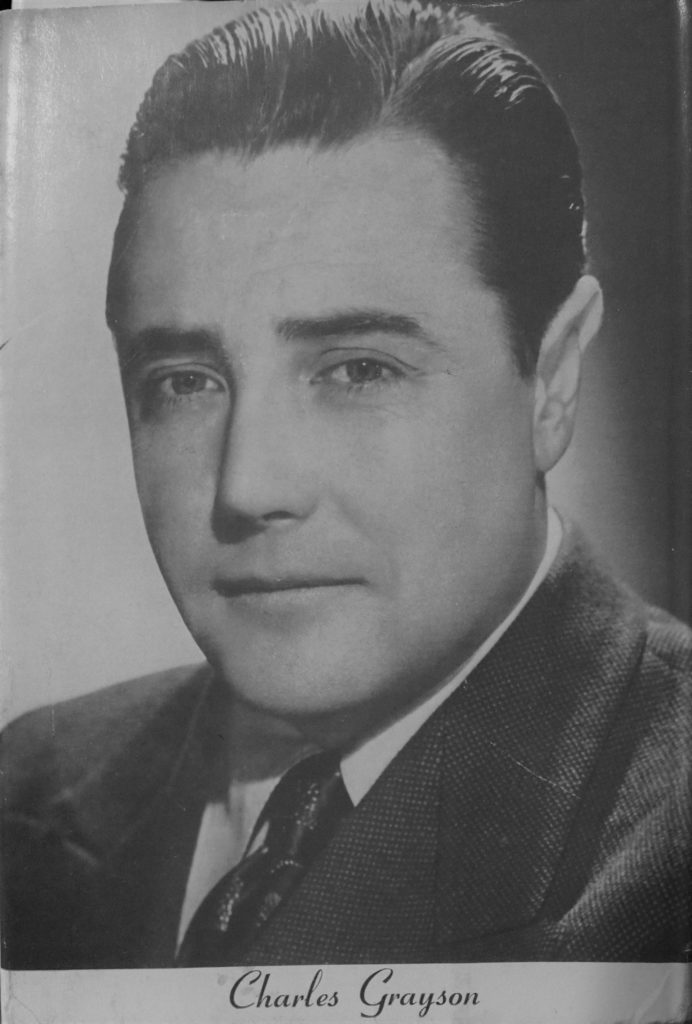
My first post about Grayson resulted from an interest in noir writers and the discovery of a book about noir writers. In the book, I found little known author and screen writer, P.J Wolfson, and his early writing collaborator, Allen Rivkin. A common thread among these writers was a friendship with the famous Hollywood director, John Huston, who lead me to Charles Grayson. Called out west by Hollywood to work , P.J. Wolfson and Allen Rivkin started writing scripts together in the early 1930’s. All three screenwriters were very young men and about the same age as they began work in a Golden Era of Hollywood.
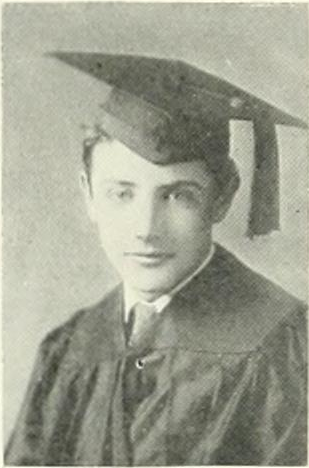
A native Californian, Charles Grayson graduated from UCLA in 1926 with a degree in English. Here’s a link to his UCLA graduation photo (Thanks to Charlotte Brown at the UCLA university archives for help in finding this source). At UCLA, he was a member of Kaps and Bells (drama) and served as the Literature committee chairman .
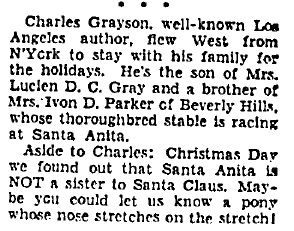
Charles Grayson had already published a few anthologies under his birth name, Charles Wright Gray. His father’s name was Lucien D.C. Gray. It is therefore likely he changed his surname to Grayson perhaps because “Gray” was too bland (but I don’t know why he changed it).
He had two sisters. One of whom, Evelyn, was married to Tom Mix’s lawyer Ivon Drouth Parker (d. 1953) who was a thoroughbreed horse breeder, member of the Los Angeles Breakfast Club, and founder of the Los Angeles County Sheriff’s Posse.
Before his stints in Hollywood, Charles Grayson did some world traveling and furthered his education by attending Harvard and the Sorbonne [source: Charles Grayson obit.- The New York Times May 9, 1973]. In Paris, he was encouraged to write by Scott Fitzgerald, Michel Arlen, and Erskine Gwynne, publisher of the Boulevardier
Eventually Grayson, Rivkin, and Wolfson, would all three become friends of director John Huston. In his book Hello Hollywood! written with his wife Laura Kerr, Allen Rivkin talks about meeting and working with John Huston and shenanigans that took place on the studio lot with P.J. Wolfson. Also in his book Hello Hollywood!, Allen Rivkin published a small account written by Charles Grayson about working with John Huston on a film set.
Charles Grayson and director John Huston shared a love for turning literature into film. No other Hollywood director has adapted so many literary works to the big screen. Huston directed and filmed – The Treasure of the Sierra Madre, The Red Badge of Courage, The African Queen, Moby Dick, A Farewell to Arms, The Night of The Iguana, The Man Who Would Be King, Wise Blood, and The Dead.
Along with John Huston, Charles Grayson joined the service in WWII. Stationed in Italy, they were part of the staff that filmed war time action under the direction of Frank Capra. Huston and Grayson remained lifelong friends and later worked on the film project The Barbarian and the Geisha together.
Here’s a photo of Captain Charles Grayson hanging out with John Huston during WWII:
During the war, Charles worked on WWII propaganda films like Underground (1941). He also got the anthology of New Stories issued as an Armed Services Edition.
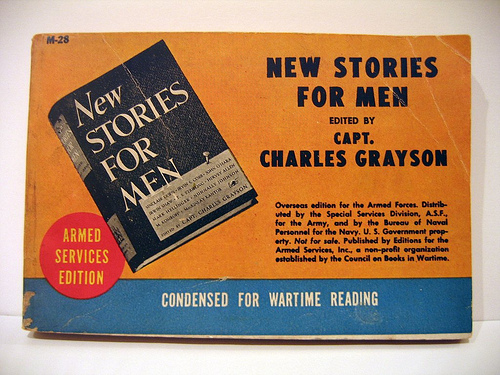
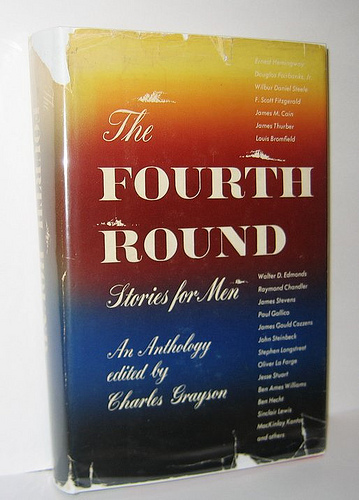
Humphrey Bogart mentions it in a preface to The Fourth Round. Bogart said, “I even encountered it among the troops of World War II in the overseas edition issued by the Special Services Editions people – shows how well it found friends”.
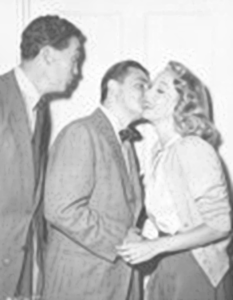
Charles Grayson would have been the best man at the 1946 wedding of John Huston (below left) and Evelyn Keyes (below right), Columbia star, if they had had a church wedding. But John and Evelyn eloped to Las Vegas on the spur of the moment and forgot to notify the best man until they returned to Hollywood. So this is a photograph of the prospective best man’s kiss to the bride on the set of JOHNNY O’CLOCK, while the groom stands by, lips puckered, awaiting his turn.
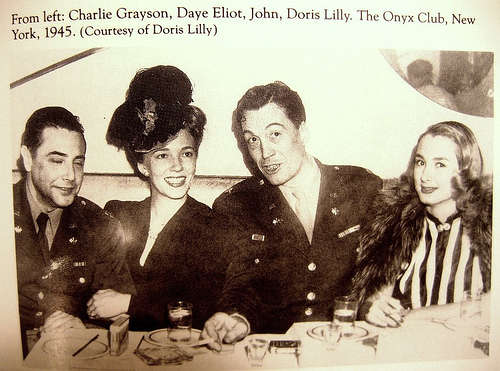
After the war, Charles was only briefly married to the pulchritudinous Daye Eliot (born Evelyn Crowell). The marriage lasted until late 1946 or early 1947 ( the April 1947 Star-Journal says he was given the “Reno Routine” by Daye).
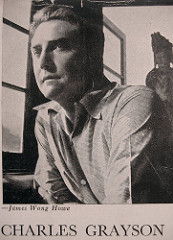
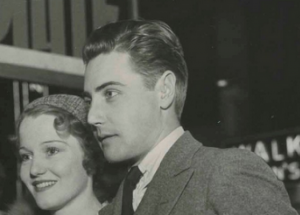
Mentioned frequently in the Hollywood gossip columns, Charles dated several women including Irene Hervey, Carole Stone, Greta Nissen, June Knight, Nancy Carroll, June Storey, Nancy Kelly, Sylvia Sidney, Joan Crawford, and film noir actress Audrey Totter (below).
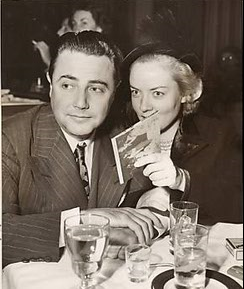
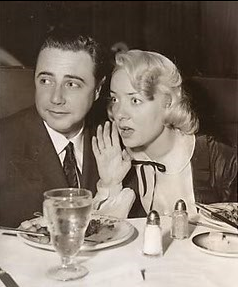
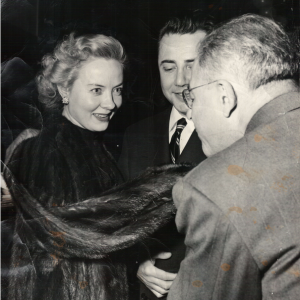
Although they were very near the altar stage, they never did tie the knot.
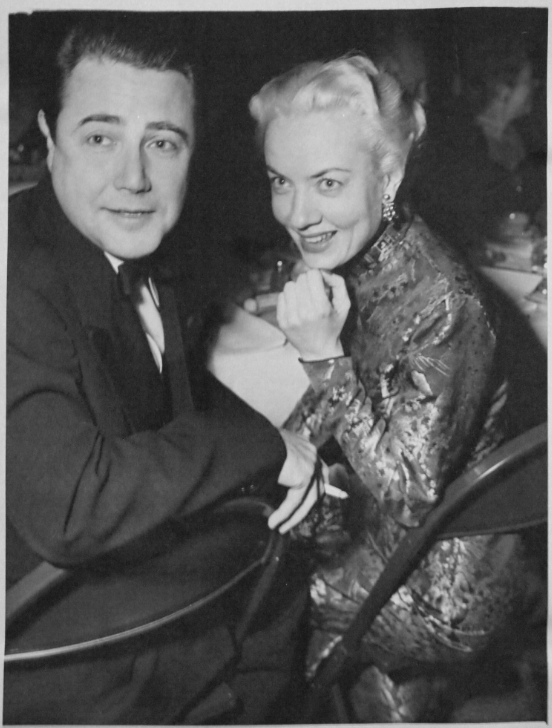
After a breakup and many months during which they sought other romantic partners, they were back together for a brief time.
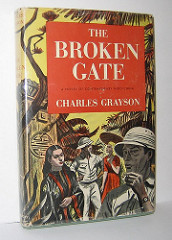
Apparently, Hollywood actresses, the war, carousing and working with John Huston wasn’t enough because his wanderlust got the better of him. He hung out with the King of Cambodia which he fictionalized in his novel The Broken Gate.
He later married his second wife, Paddy Yeatts, and died at the age of 69 in 1973.
Charles Grayson was a pseudonym. Early on in his writing career, he wrote under his name, Charles Wright Gray, and compiled several earlier anthology of short stories titled Hosses for the same publisher, Garden City Publishing, who later published Stories for Men. Another very early anthology of animal stories, Dawgs, was published in 1925. In 1927, the Kappa Sigma publication Caduceus wrote “Bernard F. Scotten of Los Angeles suggests Charles Wright Gray (Los Angeles ’26) author. Although still a very young man,” he writes, “Bro. Gray has published four books of fiction, with two more scheduled for release early in the coming year. His publishers are Henry Holt and Company of New York.” In this publication, Caduceus Volume 43 issue 1, there is photo of a young Charles Gray next to a Art White “winning the attendance cup for Delta-Nu”.
Early anthologies:
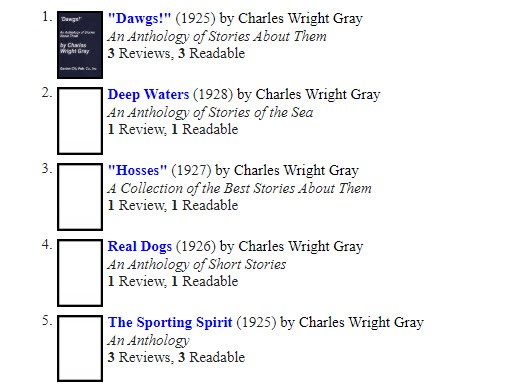
Charles Grayson put together several anthologies with writers from the late 1920’s through the 1940’s:
Stories for Men (1936)
New Stories for Men (1943)
Half a Hundred Stories for Men (1946)
The Fourth Round (1953)
The Golden Argosy (1955)
Besides his anthologies, he published several novels:
- Spotlight Madness – H. Liveright, 1931
- Everything Goes – Macaulay Company, 1932
- Original Sin – Alfred H. King 1933
- Flight South – Doubleday, 1935
- The Show Case – Green Circle Books, 1936
- Angel Town– Doubleday, 1946
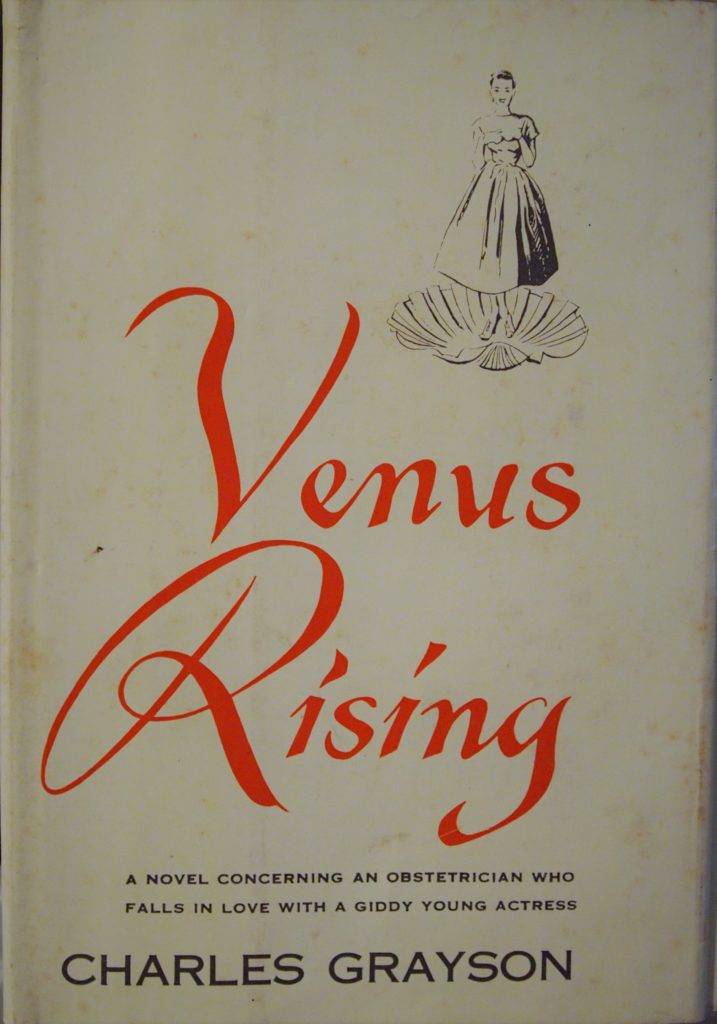
- Venus Rising – Holt, 1954
- Hollywood Doctor – Ace Books, 1954
Angel Town takes place in Los Angeles. In the book, he makes comparisons with the Los Angeles he knew as a youth.
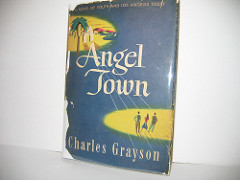
“Now a sprawling pseudo metropolis, materially prosperous in its buildings and streets and formal parks, it was if a vivid wayward child had grown up into being an emotionally blowzy woman. Uncertain food had gone into its development. Too many vagrants had fed it, too many people with little money and a huge desire to spend their remaining days in a temperate zone; too many of those who wanted nothing more than to get along. The town’s climate was too favourable to keep it from invasion, its defenses too lax to keep it self-contained.” – excerpt from Angel Town
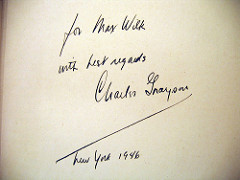
My copy of Angel Town was signed to Max Wilk who was a screenwriter himself and published Schmucks with Underwoods – Conversations with Hollywood’s Classic Screenwriters – Hal Leonard Corporation , 2004 .
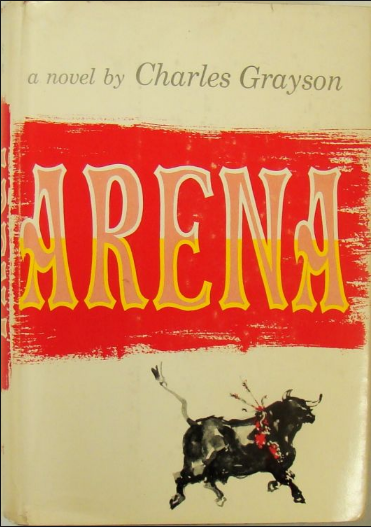
Not long ago, Charles Grayson’s nephew, Chris Pickard, emailed me with some anecdotes:
“As nephew to Paddy Grayson, I met Charles twice when I was a boy when he visited England and regret not asking him more about his life. He and Paddy lived in Beverley Hills and she used to write letters at Christmas which read like a Hollywood magazine. I remember an account of a Paul Newman party among others. When I visited Paddy in New Orleans in 1988 (Charles had died and she was now married to Dr Tom Farris) she told me how she had met Charles in London when she had been working in a hotel and he had been visiting England. Charles was much older. It was considered controversial in those days when Paddy flew off to live with him without getting married! Paddy told of their friendship with Humphrey Bogart and Lauren Bacall. Lauren was similarly married to an older man and seemed to take Paddy under her wing. I saw a photo of Charles and Paddy with HB and LB on a yacht but sadly when Paddy died there was no trace of this photo. Paddy also told me a story about filming on location in Japan (was this the Geisha film with John Huston?). Money ran out and filming stopped. One day a helicopter arrived and three men visited the set. Paddy was asked to look after this small, old man all day – he hardly said a word all day but was very polite. At the end of the day the men flew off and filming resumed. Paddy asked Charles who the man was and Charles said he was a Mafia godfather and his ‘family’ were bankrolling the film. I don’t know if this was a true story, but I cannot see why Paddy would have invented it. Paddy also said that Charles worked with John Huston on other scripts without credit, presumably making amends or doing re-writes. I don’t know which films these were, but possibly one was African Queen. She recalled going to film sets in Spain and Ireland but again I never found out which films these were or if they were Huston films. I have several books (not written by Charles) that he sent to me as Christmas presents when I was a boy and which I still treasure – I guess he wanted to share his love of books and it worked … perhaps he would be pleased to know that I became a journalist and a writer of two books and an avid reader.”
In reply to Chris Pickard:
Yes. I think he would have been very pleased. With Hollywood’s past ties to the Mafia, it wouldn’t surprise me if The Barbarian and the Geisha was financed partly by the Mob.
Thank you for contributing your memories.
With the information you provided, I was able to locate their final resting place.
Charles Grayson & Paddy Grayson Farris
Los Angeles
California, USA
Plot: Section P
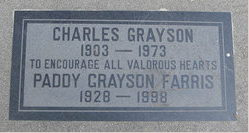
Paddy was 70 when she passed away in 1998. The age discrepancy was quite large when she meet Charles Grayson. According to her obit, Mrs. Farris was born in Essex, England, and was from Gretna. Its a long way from the small town of Gretna Green to Hollywood and I can see why it might have been scandalous!
“Because Charles Grayson, the novelist, is blessed with a sense of humor, he came to an unexpected fortune.” – George Tucker

Thank’s for your detailed notice about C. Grayson
I am a french booksailor in Paris
I’ve got one copy of RECOGNIZANCE of C. Grayson. The first Tschann Libraire’s owner, Louis Tschann, published this tale in 1935.
Best regards
yannick poirier
Yannick,
That’s a rare book. Charles Grayson had connections in Paris and knew Erskine Gwynn. What is your price?